

What is the self - heating effect of a temperature sensor?
As a temperature sensor supplier, I've witnessed firsthand the pivotal role these devices play across various industries. Temperature sensors are omnipresent, from automotive engines and industrial machinery to environmental monitoring systems. However, one phenomenon that often goes unnoticed but can significantly impact the accuracy and performance of these sensors is the self - heating effect.
Understanding the Self - Heating Effect
The self - heating effect in a temperature sensor occurs when electrical power dissipated within the sensor causes a rise in its temperature above the ambient temperature. This rise in temperature can lead to inaccurate temperature measurements, as the sensor is essentially measuring a combination of the ambient temperature and the heat generated by itself.
Let's take a closer look at how this happens. Most temperature sensors operate based on the principle of electrical resistance change with temperature. For instance, in a thermistor, a type of temperature - sensitive resistor, the resistance decreases as the temperature increases. When a current is passed through the thermistor to measure its resistance, electrical power is dissipated according to the formula (P = I^{2}R), where (P) is the power, (I) is the current, and (R) is the resistance. This dissipated power generates heat within the thermistor, causing its temperature to rise.
The magnitude of the self - heating effect depends on several factors. Firstly, the power dissipation in the sensor is directly proportional to the square of the current passing through it. So, a small increase in current can lead to a significant increase in self - heating. Secondly, the thermal resistance between the sensor and its surroundings plays a crucial role. A high thermal resistance means that the heat generated within the sensor has difficulty dissipating to the environment, resulting in a larger temperature rise.
Impact on Temperature Sensor Performance
The self - heating effect can have a profound impact on the accuracy of temperature sensors. In applications where precise temperature measurements are critical, such as in medical devices or high - precision industrial processes, even a small error due to self - heating can lead to significant problems.
For example, in a medical thermometer, an inaccurate temperature reading caused by self - heating could misdiagnose a patient's condition. In industrial processes, incorrect temperature measurements can lead to sub - optimal product quality or even equipment failure.
In addition to accuracy, the self - heating effect can also affect the response time of the sensor. As the sensor's temperature rises due to self - heating, it may take longer to respond to changes in the ambient temperature. This delay can be particularly problematic in dynamic applications where rapid temperature changes need to be detected.

Mitigating the Self - Heating Effect
As a temperature sensor supplier, we are well - aware of the challenges posed by the self - heating effect, and we offer several solutions to mitigate it.
One approach is to reduce the current passing through the sensor. By using a lower current, the power dissipation and thus the self - heating can be minimized. However, this approach has its limitations, as a very low current may result in a weak signal that is difficult to measure accurately.
Another solution is to improve the thermal coupling between the sensor and its surroundings. This can be achieved by using a heat sink or by placing the sensor in a thermally conductive medium. By enhancing the heat transfer from the sensor to the environment, the temperature rise due to self - heating can be reduced.
We also offer sensors with built - in compensation mechanisms. These sensors are designed to measure and correct for the self - heating effect, ensuring more accurate temperature measurements.
Real - World Applications and Our Products
In the automotive industry, temperature sensors are used to monitor various parameters such as engine coolant temperature, intake air temperature, and oil temperature. The self - heating effect can be a significant issue in these applications, as accurate temperature measurements are essential for optimal engine performance and fuel efficiency.
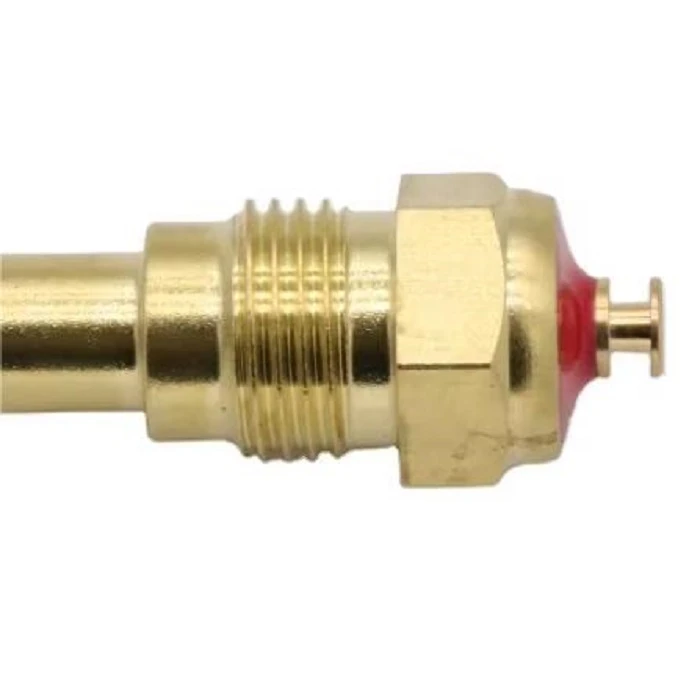
We offer a range of high - quality temperature sensors for automotive applications, such as the Cooling Water Temperature Sensor 8942356910 and the Cooling Water Temperature Sensor 3922021320. These sensors are designed to minimize the self - heating effect and provide accurate temperature measurements even in harsh automotive environments.
In industrial applications, temperature sensors are used for process control, equipment monitoring, and environmental monitoring. Our Temperature Sensor 392304A700 is a popular choice for industrial users. It is highly reliable and has been engineered to reduce the impact of self - heating, ensuring stable and accurate temperature measurements over a wide range of operating conditions.
Conclusion
The self - heating effect is a critical factor that can affect the performance and accuracy of temperature sensors. As a temperature sensor supplier, we understand the importance of addressing this issue and have developed a range of solutions to mitigate its impact. Our high - quality sensors are designed to provide accurate temperature measurements even in challenging environments.
If you are in need of temperature sensors for your application and want to learn more about how we can help you overcome the self - heating effect, we invite you to contact us for a procurement discussion. We are committed to providing you with the best - in - class temperature sensing solutions tailored to your specific needs.
References
- Dally, J. W., Riley, W. F., & McConnell, K. G. (1993). Instrumentation for Engineering Measurements. Wiley.
- Fraden, J. (2010). Handbook of Modern Sensors: Physics, Designs, and Applications. Springer.
- Woudenberg, R., & van der Ziel, A. (1962). Self - heating in semiconductor thermistors. Journal of Applied Physics, 33(1), 134 - 140.